When summer hits, there's nothing more valuable than a great air conditioner and with the right unit you can cool your house effortlessly.
Pricing on central AC units is a bit complicated. The manufacturers, in many cases, don’t let you price shop online or even in the store.
 If you're interested in personalized prices specific to your needs and area, simply follow this link . As soon as you fill out the form, you'll receive free quotes from up to four top-rated central air conditioning contractors in your area. QualitySmith’s network of contractors is very selective, and we verify that they hold up to date insurance and state licenses.
This quote from the Trane website is fairly typical of most manufacturers:
“Because a central heating and air conditioning system is not an off-the-shelf product, it requires a professional dealer to assess and install a system that’s right for your home. There is no MSRP. Multiple factors enter into the purchase price of your new system, such as: the seasonal temperature where you live, the type and age of your home, the interior duct work inside your home, local or state regulations and available tax rebates.”
They’re right and they’re not. There are a lot of variables that can go into the cost of installing a central AC unit into a home:
- Size in square feet
- Kitchens
- Sunny rooms
- Existing or new ductwork
- Insulation
- Region
- Laws and regulations
- Tax credits and rebates
All of this is true, as Trace and most of the other manufacturers will tell you. Nonetheless, the actual unit itself should be a single price. It shouldn’t be difficult for you to be able to compare a 2 ton 16 SEER AC unit from one company to the other (we’ll explain those terms in a moment). It might not be an infallible system of pricing, but it would at least give consumers a benchmark to work from. The manufacturers don’t make it easy with one very notable exception: Goodman.
Goodman air conditioner prices are readily available online. A simple Google search will turn up various sizes and efficiencies, making it easy to compare SEERs one to the other.
In this article, we will give you reliable information on the costs of the units. The rest, as you will see below, maybe variable, but it is a bit predictable.
Size and Strength: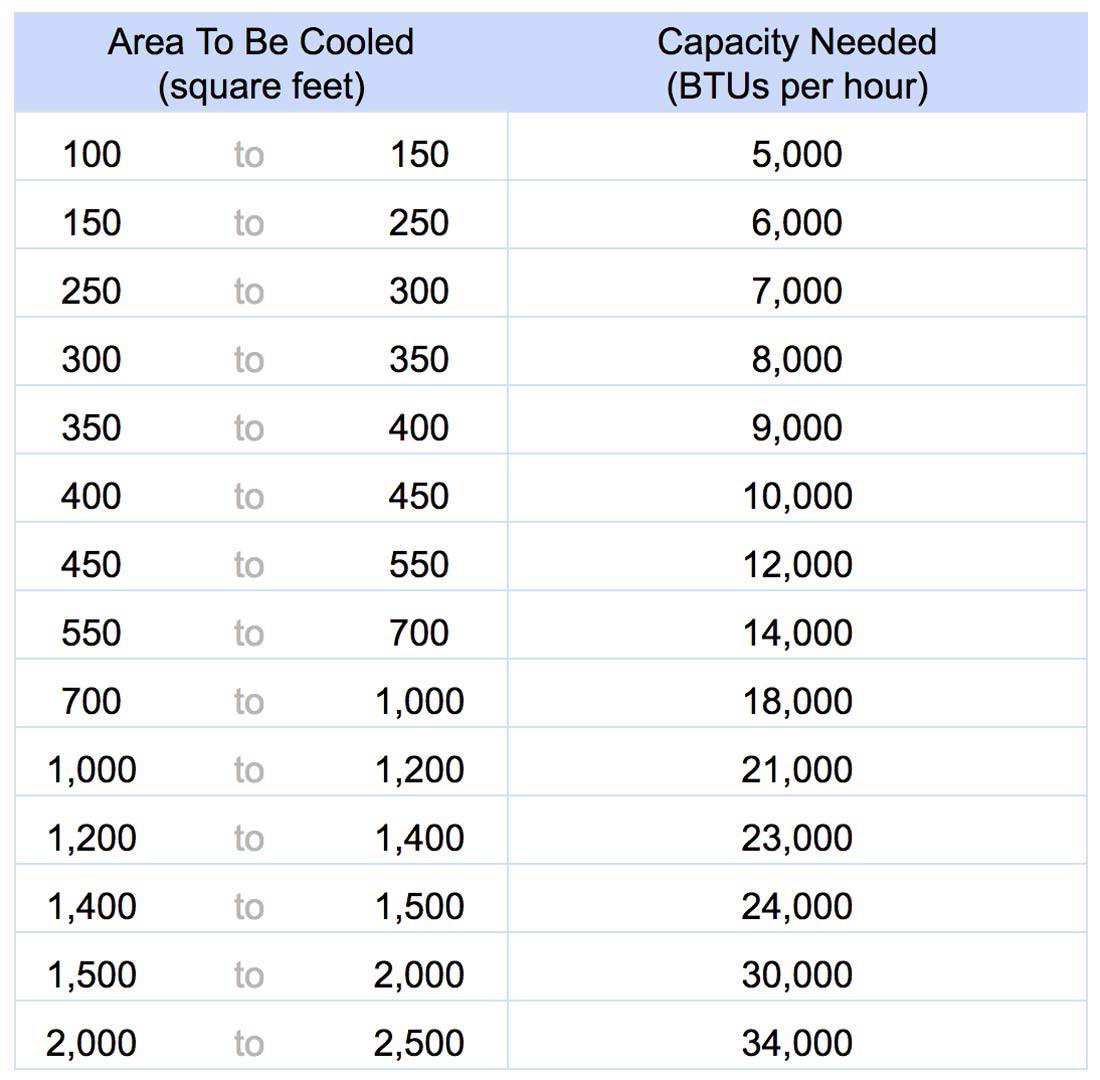
When calculating the number of BTUs per hour that your home needs to stay nice and cool, there are a number of factors. The most important is square footage. Some other factors to consider:
Sunny rooms:BTUs - British Thermal Units are a measure of the amount of energy it takes to cool or heat something. Technically, it’s heating (or cooling - removing heat) from one ounce of water by one degree Fahrenheit.
Like horsepower, this is simply a number. It’s not terribly important what a BTU is exactly, just how many do you need.
The chart will help you decide what size AC unit you will need.
Note: There are a lot more factors just BTU, so some professional estimates will be important to get.
If you have rooms that are exposed to a lot of sunshine, you will need compensate for that. Southern facing rooms are wonderful in the winter, because they can warm up even with a cold winter sun. In the summer, though, these rooms can quickly become ovens that nearly impossible to cool.
Estimating how much you will need to add to the size of your AC unit for the sun is really a job for a professional. A local pro can calculate the impact of the sun and amount of glass that you have, etc.
Kitchens:
Your kitchen is the only place in the house where you will be generating heat, even in the height of summer. For a kitchen, you need to add another 4000 BTUs of power.
For example, for a 1000 square foot house, you need to have approximately 22,000 BTU per hour. 18,000 for the house and another 4,000 for the kitchen.
This same chart applies for window air conditioners, so you can use this to decide a couple of window units will be sufficient.
Tons versus BTU
When you start shopping for AC units you’ll see them measured in tons. This isn’t the weight of the unit. It actually refers to the number of tons of ice that would be needed to have the same effect.
The conversion of tons in an AC unit to BTU is simple: 1 ton = 12,000 BTU. So that means that a 2 ton AC unit will cool up to 1500 square feet.
SEER and unit cost
SEER is the measurement of the efficiency of an air conditioning unit. It stands for Seasonal Energy Efficiency Ratio. This is the calculated efficiency of air conditioners and heaters. The higher the SEER number, the more efficient the unit is.
In the United States, it’s illegal to sell any unit that is below 13 SEER. This means that now, even the least efficient units available are much more energy efficient than the ones that we sold in the 1970s.
The maximum residential SEER levels are about 22, though there are some units that are much more efficient available in the world.
Unit Price versus Efficiency
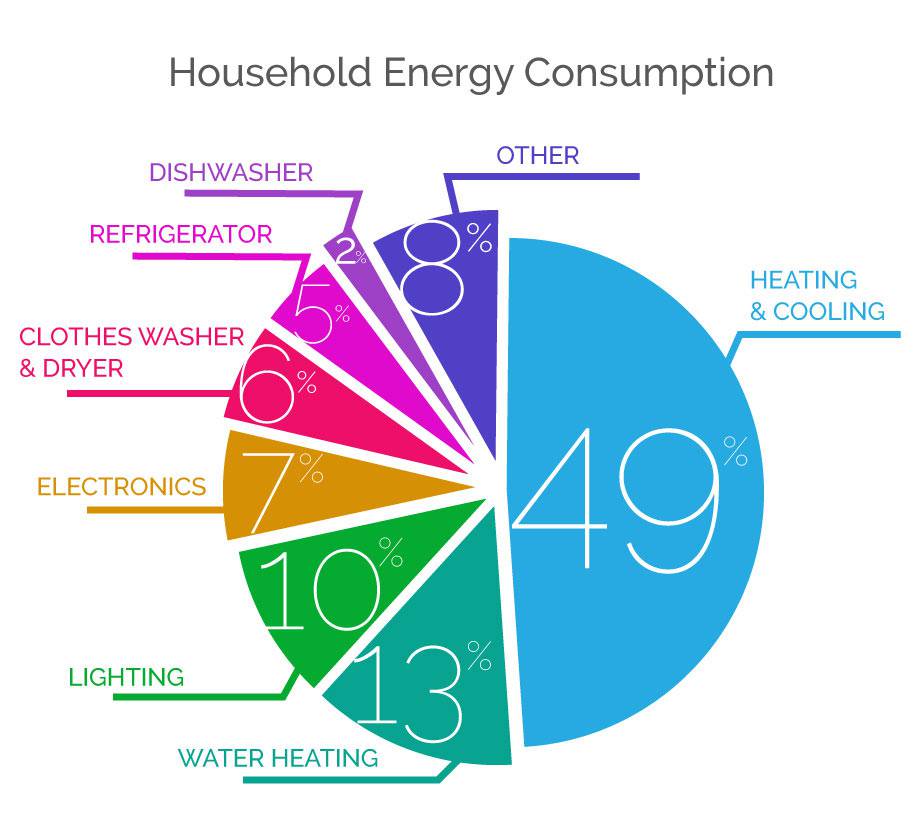 When purchasing an air conditioner unit, there is a trade off between the initial cost of the unit versus your projected savings over time.
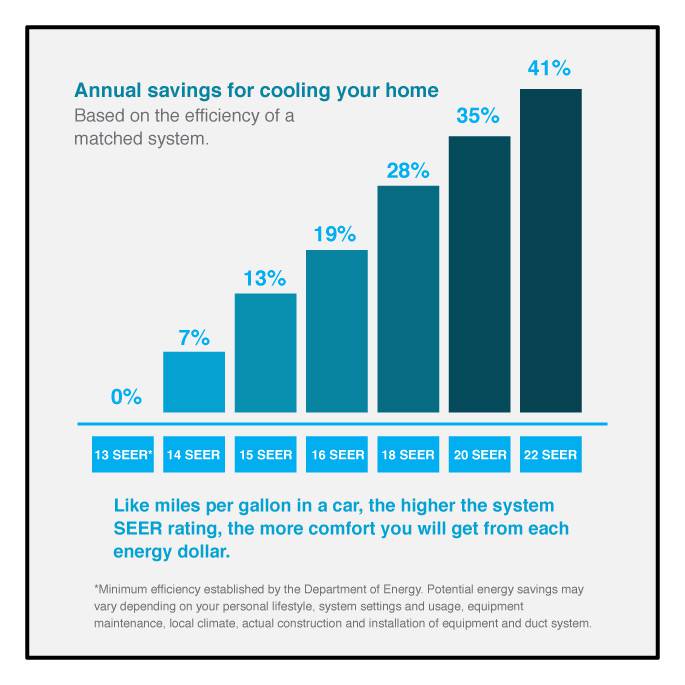
When calculating the cost savings on a specific SEER rating, you can use the chart below to figure out where you’re at and how much you might save.
Assume for moment that you have a 13 SEER air conditioner. When you go shopping for a new unit, use this guide to make the approximate calculations of how much you will save. If your unit is even less efficient, like a SEER 8, you will save a lot more.
The Lennox Company offers an excellent and dynamic cost savings calculator .
Using this web page, you can see the average cost savings for your state or province, using the SEERs of the units you’re considering.
For example, using the US national average energy costs, the energy savings between SEER 10 and SEER 25 units is about $2,835. This sounds like a lot, but the cost difference between the least efficient and the most efficient models is about $5,000 That means that you will lose money even over 15 years. However, the cost savings between SEER 10 and SEER 17 is about $2000. If you’re in California, the savings is about $3000. This can more than cover the costs of the unit. Another factor to consider if that energy will likely become more expensive, rather than leveling off or going lower over time.
Energy Savings Tax Implications
In many places, you will receive a significant tax credit buying a high efficiency air conditioner. In many places, especially California, you will be reimbursed for much of the cost differences as those regions strive to improve air quality and reduce carbon emissions.
The Very Least to Know about SEER
When you are searching for a central air conditioning unit, SEER will be the benchmark of your energy savings. When you are comparing one unit to another, use the Lennox calculator to get a sense of how much you will save on energy over time. Remember: this number is like the estimated mileage on a car; it’s just an educated guess, not a solid number.
Installation of Your Central AC Unit
Installing your AC unit is a job for a pro. If you don’t have any duct work installed, you will need to have someone go through your house and plan how to get everything installed. There needs to be power to the outside of the house, ducts into the house and then a complete forced air distribution system. This is a system that need to be based on science as much as convenience. Where you place a vent in a room can have a significant effect on how efficiently the cool air gets to every corner.
Ductwork:
Ductwork consists of pipes and metal tubes that carry cool air from your air conditioner to the vents in each room.
Some ductwork figures, as gleaned from thousands of contracts through our website and several others, is between about $8 and $13 per linear foot. This accounts for a standard installation. A particularly large or difficult installation will cost a great deal more.
The average duct installation cost is about $1100. This doesn’t include installation of the AC unit itself. This cost is just for the ductwork. When beginning your estimates, you should look at setting aside $2000 for the ductwork.
Air Conditioner Installation
The cost for the actual installation of the unit is about $2000 as well. Depending on how much ductwork you need in your home, the price itself will vary.
The installation of an air conditioning unit will typically require two technicians over two to three days. It might be a bit longer if you have to install ductwork, but these are the guidelines that you can look at.
The General Total Cost of Your Air Conditioner Installation
So… with all of that calculated out, how much should you plan for your air conditioner purchase and installation costs?
The cost of the unit itself is likely to be the largest variable. If you assume that you will pay about $2500 for an air conditioning unit, you can also assume about $2000 for ductwork and $2000 for installation. So that’s about $6500 for an average unit in an average house at average prices.
How to Know Exactly How Much Your Central AC Installation will Cost
 There is one simple and free way to know exactly how much it will cost to get a new central air conditioning unit installed: get several estimates. HVAC specialists will come to your home and give you a detailed estimate of the exact costs. They can help you to decide how large of a unit you need, how much ductwork you will need and much more.
If you want to get some estimates, just put your information here:
This form will be sent to several different contractors and you can decide whom you would like to hear from.
Top Brands and Units:
There are several factors that affect the price of the air conditioners:
- Tonnage - A larger air conditioner is much more expensive.
- If you only need a 4 ton AC versus a 1 ton AC, the price will be significantly higher.
- SEER - The more efficient an AC unit is the more expensive it will be.
- Location - Prices vary depending on the region that you are in.
- Time of year - Having an AC installed in autumn will be less expensive than doing it in June.
Many of the prices below are the actual reported price according to consumers. These reports, online, are voluntary and cannot be independently verified. Other prices were derived from internet searches where providers lis ted the prices. No price is guaranteed until you have gotten several signed and verified estimates.
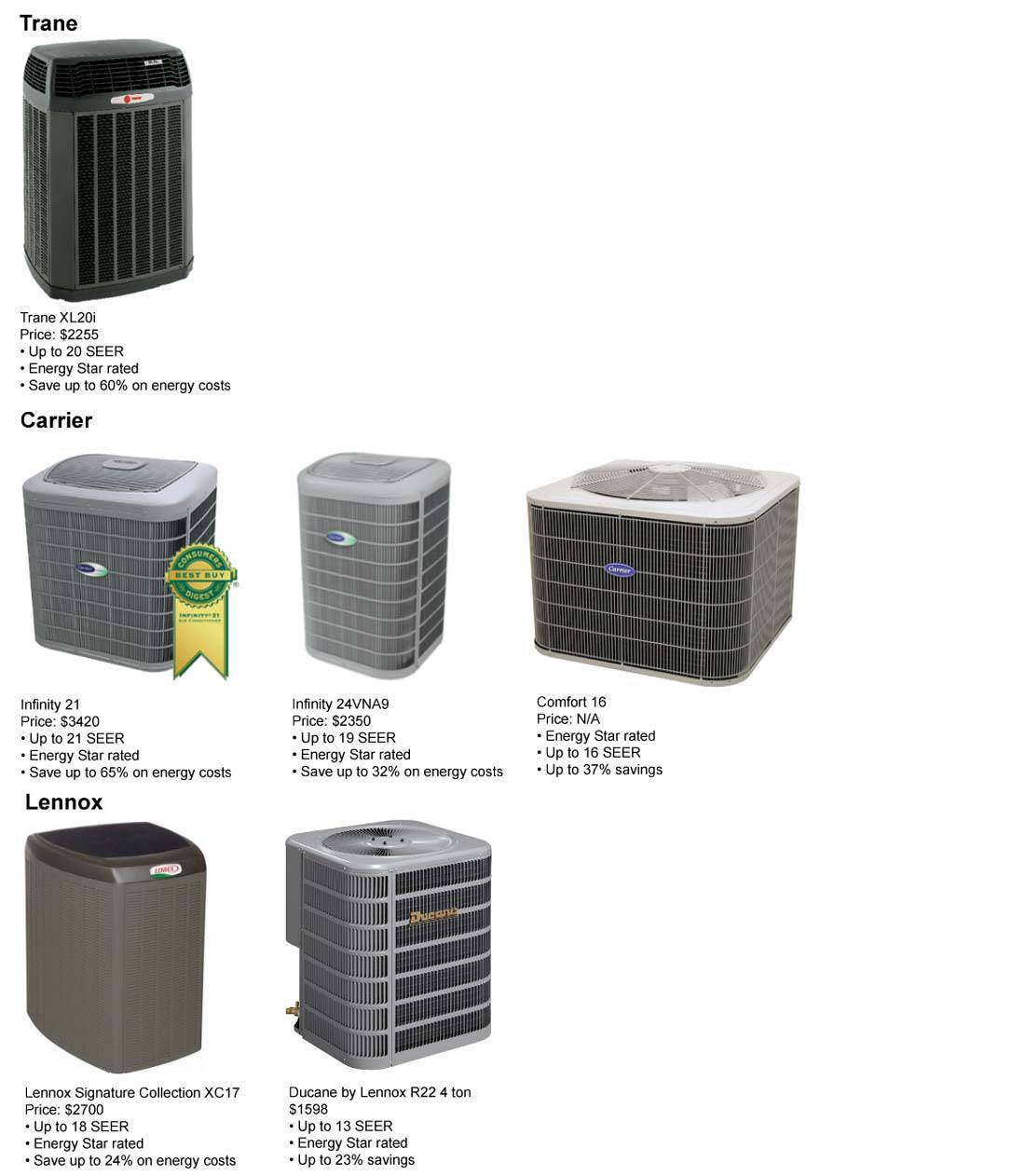
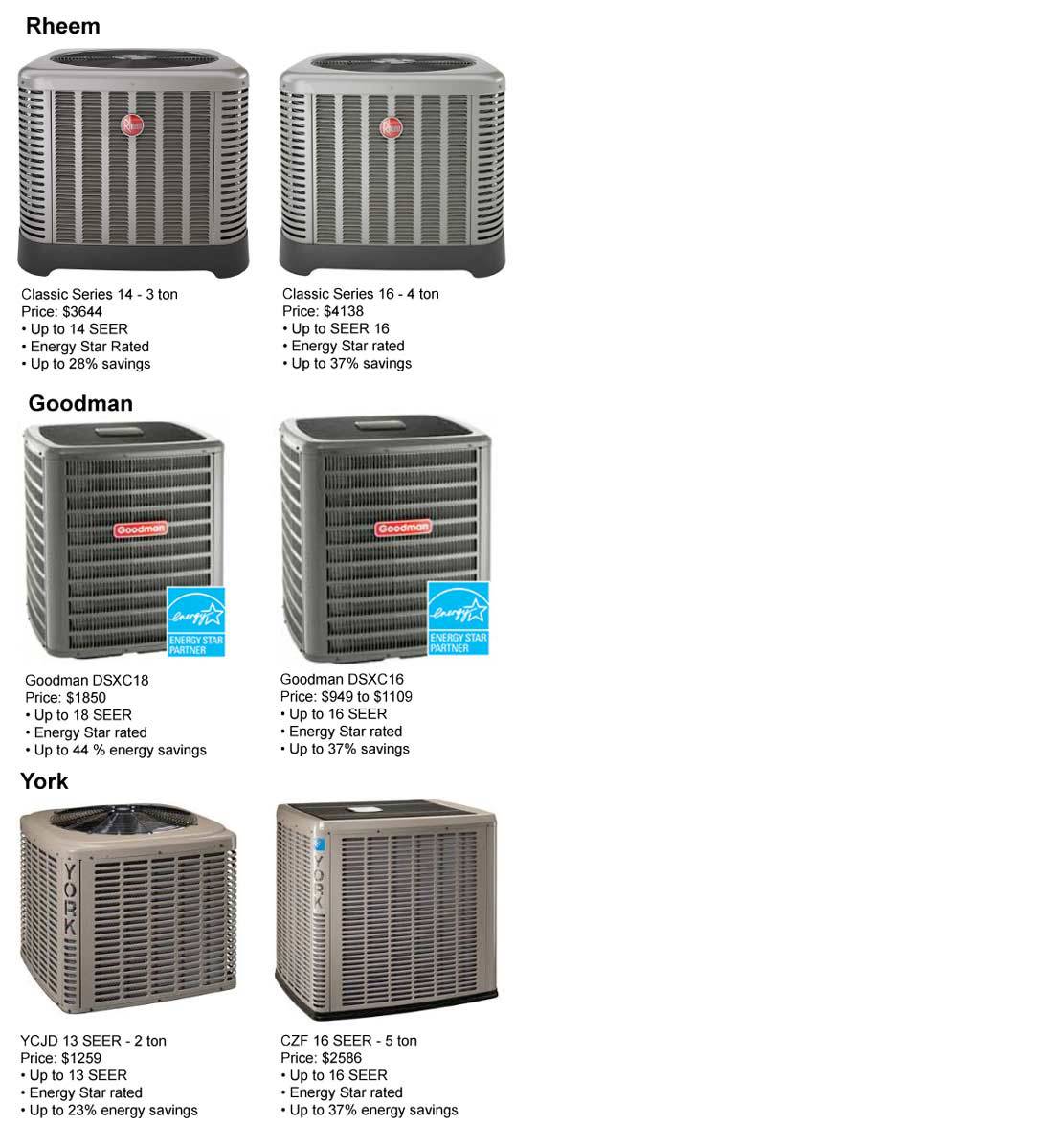
If you need specific prices for popular AC brands, see the following in-depth guides. Estimated prices of 2.5-ton models show to the right:
- Aire-Flo — $1,680 .
- Amana — $2,550 .
- American Standard — $3,195 .
- Armstrong — $1,990 .
- Bryant — $2,160 .
- Carrier — $3,220 .
- Coleman — $1,740 .
- Comfortmaker — $1,740 .
- Frigidaire — $2,910 .
- Gibson — $2,265 .
- Goodman — $2,125 .
- Heil — $2,630 .
- Lennox — $3,410 .
- Payne — $1,400 .
- Rheem — $2,450 .
- Ruud — $2,440 .
- Tempstar — $1,830 .
- Trane — $3,290 .
- Whirlpool — $1,910 .
- York — $2,770 .
Need a quick review of AC lingo? Check out "Air Conditioner Buyers Guide" .
Need to prepare for next season too? See "Furnace Prices: Types, Taxes and Cost" .



Write a Comment